Concept C1 Flat + High Contrast

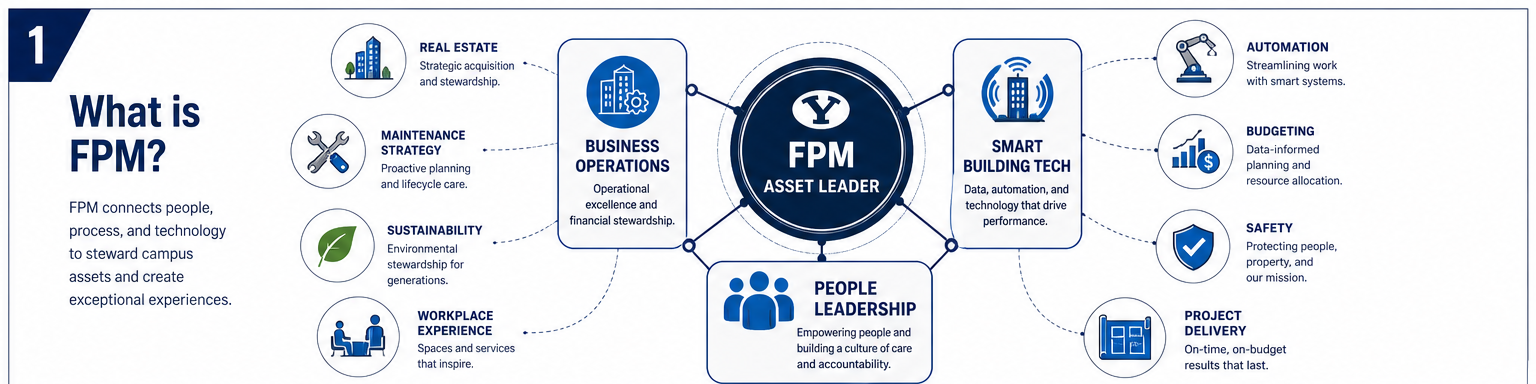
What is FPM?

Facility and property management is leadership work tied to real places.

BYU describes FPM as the development and management of facilities and properties. The work stretches from idea and repurposing to daily operation and long-term stewardship.

Plain-language field definition

Think of FPM as running the built environment after it opens.

A facility manager helps spaces keep serving the people and organizations that use them. That can mean office towers, hospitals, campuses, manufacturing plants, sports venues, or mixed-use property.

The job mixes communication, technical awareness, planning, and business judgment. You are not only looking at walls and equipment. You are helping a building stay useful, safe, flexible, and financially responsible.

Where graduates fit

FPM is broad because buildings show up everywhere.

Education and campus spaces

Universities need leaders who can keep classrooms, labs, housing, and shared spaces working.

Commercial and mixed-use property

Property teams manage leasing pressure, tenant needs, vendors, and long-range upkeep.

Healthcare, events, and specialty facilities

Some spaces never really pause, which raises the need for calm coordination and clear systems thinking.

What students build

The major pairs management thinking with real building context.

The BYU catalog requires 300 hours of pre-approved construction- or facilities-related work after students declare the major. That moves the degree beyond classroom talk.

The program requirements page also points students to a current flow chart, so the path is not just “take some business classes and hope.” There is a visible major structure and an expected sequence.

Role examples named in the brochure

  • Facilities engineer
  • Property manager
  • Sports and event manager
  • Campus facilities manager
  • Temple engineer
  • Project manager

Core BYU sources used here

`What is FPM?`, the FM brochure PDF, `FM Program Requirements`, and the BYU catalog major page.